Quick introduction to Object oriented concepts in Java - Part 2 of series
Chapters
Inheritance
This tutorial is a follow up from the part 1, where we introduced Java Language.
Inheritance
Inheritance is the major block in object oriented programming language has it helps in hierarchical classification. Inheritance is a process wherein a new object or class is derived from an existing objects or class. The class derived from another class is called as subclass whereas class from which a subclass derived is called as a superclass. Therefore A subclass is special version of superclass which as methods and variables of it along with added its own unique elements. A subclass has only one superclass whereas a superclass will have one or more subclasses
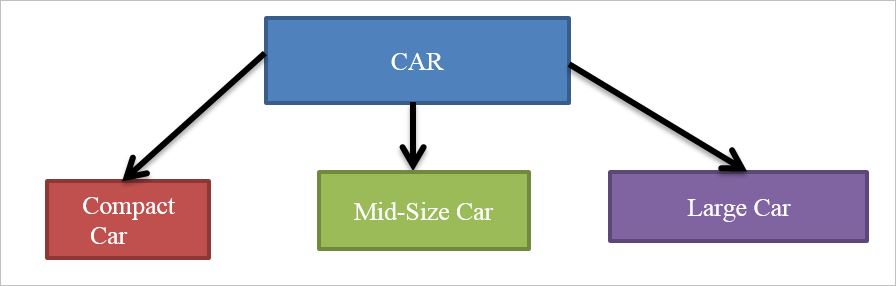
In the above figure CAR class is a Super Class which is extended to Sub Class like Compact Car, Mid-Size Car and Large Car.
We can inherit a definition of class into another class with using extend keyword. Below is syntax for it.
class subclass-name extends superclass-name {
//  // A class body
}
Below is the simple code which explains inheritance. The Program has creates a SuperClass called X and a SubClass called Y. We are using extends keyword to a create subclass of X.
// Create superclass.
class X {
	int a, b;
	void showab() {
		System.out.println("a and b: " + a + " " + b);
	}
}
// Create subclass by extending class X.
class Y extends X {
	int c;
	void showc() {
		System.out.println("c: " + c);
	}
	void sum() {
		System.out.println("a+b+c: " + (a + b + c));
	}
}
class SimpleExampleInheritance {
	public static void main(String args[]) {
		XsuperClassObj = new X();
		YsubClassObj = new Y();

		superClassObj.a = 5;
		superClassObj.b = 10;

		System.out.println("ContentsuperClassOb: ");
		superClassObj.showab();
		System.out.println();
		/* public members of  superclass can be accessed by subclass */
		subClassObj.a = 1;
		subClassObj.b = 2;
		subClassObj.c = 3;
		System.out.println("Contents subClassOb: ");
		subClassObj.showab();
		subClassObj.showc();
		System.out.println();
		System.out.println("Sum of a, b and c in subClassObj:");
		subClassObj.sum();
	}
}
The output:
Contents of superClassOb:
a and b: 510
Contents of subClassOb:
a and b: 1 2
c: 3
Sum of a, b and c in subClassOb:
a+b+c: 6
In the above example the subclass Y has all the member of its SuperClass X. So the subClassObj can access a and b and also method showab(). Even though X is a superclass for Y it is completely independent and stand-alone class.
Things not possible with java class Inheritance?
- Private members of superclass are not inherited by subclass and can be accessed indirectly.
- Members having default accessibility in superclass are not inherited by subclasses in other packages as these members only are accessible by names in subclasses within same package as superclass.
- Since initialize and constructors blocks are not members of class they are not inherited by subclass.
- A subclass can extend only a one superclass.
Description
This tutorial will introduce you to Object oriented concepts in Java. Basic definitions and learning with code examples.
This tutorial has subdivided into 7 parts as listed below
- Understanding Inheritance
- Understanding Overrides
- Understanding Polymorphism
- Understanding Abstraction
- Understanding Encapsulation
- Understanding Interfaces
- Understanding Packages
Let us know if you found any error in this tutorial. Your feedback is welcome as always.
Audience
Students seeking a quick overview on Java Programming language and its Object oriented features.
Learning Objectives
Learn Object Oriented concepts in Java language.
Author: Subject Coach
Added on: 10th Mar 2015
You must be logged in as Student to ask a Question.
None just yet!